
What is a Digital Product Passport (DPP)? Complete Guide
Learn what a Digital Product Passport is, how it works, and how the EU is rolling it out across ESPR and sector-specific product laws.
Registry status, 20 September 2026: Regulation (EU) 2026/1778 entered into force on 6 August 2026. Production and test Registry environments are available, but User Guide v1.03 of 16 September still states that battery-passport registration cannot complete because its semantic catalogue is not defined. Infrastructure availability does not create a universal product obligation.
What is a Digital Product Passport?
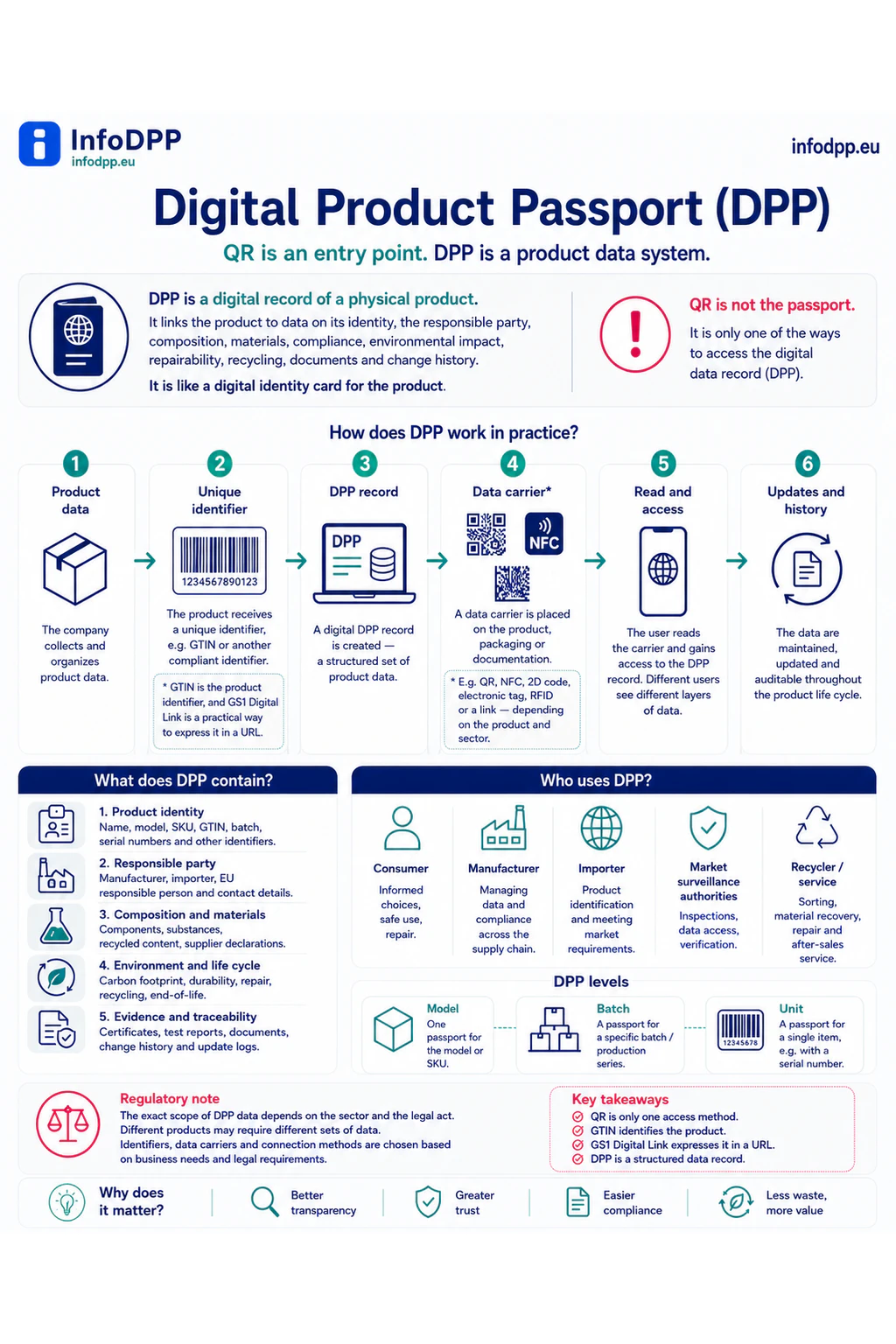
A Digital Product Passport (DPP) is a structured digital record linked to a physical product, model or batch. Depending on the applicable law, it can contain identity, conformity, composition, environmental, repair or end-of-life information. Think of it as an “identity card” whose mandatory fields and access rights vary by product regime.
The Ecodesign for Sustainable Products Regulation (ESPR), Regulation (EU) 2024/1781, creates the main horizontal framework for future DPP categories. At the same time, some sectors already have standalone DPP obligations under other EU product laws, so “DPP” does not always mean the same data model or the same application date.
How Does a DPP Work?
The process is straightforward:
- The responsible economic operator ensures that the DPP exists at the product, model or batch level required by the applicable law; it may operate the system itself or use an authorised provider
- A unique product identifier issued under a compatible scheme is assigned to the product; ISO/IEC 15459-6 is referenced by ESPR, while GTIN is one practical option rather than a universally mandated identifier
- A data carrier (for example a QR code) points to the product’s unique digital record; its placement depends on the applicable product rules
- A user scans or resolves the data carrier: the accessible information depends on the role and the applicable product rule; authorities can also use Registry and customs-system connections rather than relying on a consumer scan
- Data follows the required format: ESPR Article 10 provides for structured, searchable and, as appropriate, machine-readable data. Technical acceptance alone does not demonstrate compliance with substantive product requirements.
Identifier Technology: GS1 Digital Link and ISO/IEC 15459
The ESPR requires each DPP to be linked to a unique product identifier and accessible via a data carrier (e.g., a QR code). The regulation references the ISO/IEC 15459 standard series for identifiers. It does not name GTIN or GS1 as the universal legal solution; a Global Trade Item Number (GTIN) is one practical implementation where it fits the selected identifier scheme and product hierarchy.
GS1 Digital Link is a URI syntax standard that defines how product identifiers (such as GTIN) can be structured within a web URL. It provides a way to express a product identifier as a standard HTTP URL, one that can be encoded in an ordinary QR code and opened in any web browser, pointing directly to the product’s digital information.
⚠️ Regulatory note, updated 16 July 2026: The ESPR does not mandate GS1 Digital Link by name. The Official Journal now contains the references to six horizontal DPP standards, including EN 18219 (unique identifiers) and EN 18220 (data carriers), through Decision (EU) 2026/1736. That gives a presumption of conformity only to the extent covered by those standards; sector-specific requirements and the format for a particular category may still come from a separate act. GS1 standards remain a practical, interoperable option, but the ESPR does not name them as the only mandatory format. What the Decision changes →
URL Structure
https://resolver.example.com/01/{GTIN}/10/{LOT}/21/{SERIAL}Where:
/01/{GTIN}, identifies the product model (SKU)/10/{LOT}, identifies the production batch/21/{SERIAL}, identifies the individual unit
Three Levels of Granularity
| Level | What it identifies | Example |
|---|---|---|
| Model | An entire product line | ”White Oxford Shirt” |
| Batch | A specific production run | ”March 2026, cotton bale #42” |
| Item | A unique individual unit | ”Serial number SN-000471” |
The applicable product rule determines the required level. Regulation 2026/1778 then requires Registry registration at that model, batch or item level; where more than one Union act applies, the most granular level prevails.
What the EU DPP Registry Does
The Registry is a central registration and verification layer, not a database containing the complete passport. It records high-level registration data, including the product identifier and, where relevant, the commodity code, and issues a unique registration identifier. The detailed DPP remains decentralized with the economic operator or provider. Production and test access opened on 20 July 2026, and the Commission states that registration is available through a secure interface or API. Test activity uses a separate EU Login and is neither migrated to production nor guaranteed to persist; individual product groups still depend on the relevant semantic catalogue and sector rules.
Where registration applies, the registrant must be verified, the system checks the technical consistency and semantic conformity of the registration, and registry data is versioned and logged. Those technical checks do not certify that a product meets all substantive DPP or product-law requirements. The Commission also maintains the semantic repository that supports common, machine-readable data models.
What Data Does a DPP Contain?
The specific data requirements depend on the applicable sector law. The themes below are illustrative, not a universal checklist. A field belongs in the passport only where the relevant act requires or permits it.
Product Identity
- Product name and model
- Manufacturer details
- Origin information where required
- Unique product identifier (GTIN is one possible implementation)
Sustainability Data
- Carbon-footprint information calculated under the prescribed method, where required
- Recyclability or circularity information where defined by the applicable act
- Recycled-content information where required
- References to supporting environmental evidence where the legal data model permits or requires them
Composition & Materials
- Material or ingredient breakdown at the level required for the product
- Substances-of-concern or chemical information where required
- Hazardous-material information with the access level set by the applicable law
Lifecycle Information
- Care and maintenance instructions
- Repair information and spare parts availability
- End-of-life disposal/recycling guidance
Who Needs a DPP?
DPP obligations only apply where the product falls within the scope of a DPP requirement, either a standalone framework (batteries under Reg. (EU) 2023/1542, construction products under Reg. (EU) 2024/3110, detergents under Reg. (EU) 2026/405, toys under Reg. (EU) 2025/2509) or a delegated act adopted under the ESPR (Reg. (EU) 2024/1781). Construction products still need their sector-specific delegated implementation before a universal product-level date can be stated. For products in scope, responsibilities flow across the supply chain:
- Manufacturers: primary responsibility for creating and maintaining the DPP for in-scope products
- Importers: must ensure imported in-scope products have a valid DPP before placing them on the EU market
- Distributors: must verify DPP availability before selling in-scope products
- Online and distance sellers: must make the carrier or passport information available where the applicable product law imposes that duty
Timeline: Confirmed Requirements and Indicative Signals
DPP requirements are being rolled out in phases. Some sectors already have confirmed binding deadlines under standalone regulations, while others depend on future ESPR delegated acts:
The confirmed group already shows that DPP can mean an item-level passport, a model-level passport, or a safety/conformity passport depending on the legal basis.
Confirmed legal frameworks and dates
- Batteries: Regulation (EU) 2023/1542: battery passport mandatory from 18 February 2027 at individual-battery level, but only for the battery categories covered by Article 77
- Detergents: Regulation (EU) 2026/405: model-level DPP mandatory from 23 September 2029, aligned with UFI and the physical/digital label architecture
- Toys: Regulation (EU) 2025/2509: DPP mandatory from 1 August 2030, with Annex VI as the minimum passport content for safety, conformity, and traceability
- Construction products: Regulation (EU) 2024/3110 creates a separate CPR DPP framework, and Regulation 2026/1778 expressly covers CPR passports in the Registry. CPR Article 22(7) ties manufacturer availability to 18 months after the Article 75 system act enters into force. The Commission’s current indicative timeline points to that delegated act in Q2 2027, but the adopted act still has to fix the binding calendar and operational scope.
- Vehicles: Regulation (EU) 2026/1738, Article 13, requires a digital circularity vehicle passport from 1 September 2032 for vehicles placed on the market within the relevant M1/N1 scope, subject to Article 2 exclusions.
Indicative (awaiting delegated acts under ESPR)
The first ESPR Working Plan (adopted 16 April 2025) and the Commission’s DPP timeline provide indicative planning signals. A binding application date and transition period must be read from each adopted delegated act.
- Textiles: First-wave priority; the current Commission timeline signals delegated-act adoption in Q3–Q4 2027 and DPP application in 2029
- Tyres: Included in the first working plan; the current timeline signals a delegated act in Q3–Q4 2027 and DPP application in 2029
- Iron and steel: First-wave priority; the Commission timeline signals the delegated act in Q4 2026 and DPP application in 2028
- Electronics and digital equipment: included in the working plan; the Commission timeline signals DPP application in 2029, subject to the adopted act
- Furniture: included in the working plan; the Commission timeline signals a delegated act in 2028, while the binding application date remains to be fixed
Getting Started
Preparation can start with the information available for one product. Self-service platforms like OriginPass.eu allow manufacturers to:
- Build and test structured DPP records against the selected sector template; platform output alone does not guarantee legal compliance
- Plan data carriers and identifiers for the product, label, packaging or documentation where the applicable rules allow or require them
- Manage product data across multiple languages
- Configure privacy-respecting access measurement only where the applicable law and consent basis permit it; some sector rules expressly restrict tracking
Read Next
- How to Create a DPP: Step-by-Step Guide for Manufacturers
- DPP Data Requirements: What Information Goes into a Digital Product Passport?
- DPP Data Classification: Essential, Recommended, or Voluntary?
- DPP Service Provider Requirements: EU Rules for Platforms
- Explore DPP industries and sector readiness
Official Sources
- Commission Implementing Regulation (EU) 2026/1778 (DPP Registry)
- European Commission: DPP Registry
- European Commission: Digital Product Passport hub and indicative timeline
- ESPR Regulation (EU) 2024/1781
- European Commission ESPR Working Plan 2025–2030
- Battery Regulation (EU) 2023/1542
- Toy Safety Regulation (EU) 2025/2509
- Detergents Regulation (EU) 2026/405
- Construction Products Regulation (EU) 2024/3110
- Regulation (EU) 2026/1738, Article 13
- DPP Registry: v1.03 (2026-09-16)
- Ecodesign / Green Forum implementation updates
Ready to create your first digital product passport? Try OriginPass.eu and start with one product.